

Review
Most societies frame motherhood as the pinnacle of aspiration and fulfillment for women, albeit through a patriarchal lens. Some go a step further, attaching divine reverence to motherhood itself, if not always to the women who actually become mothers. Latin America's most famous example is the Virgin of Guadalupe, an apparition of the Virgin Mary in Spain whose cult conquistadors brought to Mexico. Her image appears in shrines, art, and shops across Mexico and Latin America, but in the forest of Ocuilan, Mexico, this monument to motherhood takes a literal form: a massive 100-foot-tall golden statue towering over the forest.
Valeria (Natalia Solián) climbs endless steps to the monument, where her mother asks the Virgin to bless her with fertility so she and her husband, Raúl (Alfonso Dosal), can conceive. Valeria seems unsure whether she even wants to be a mom, but that becomes moot when she finds out she's pregnant soon after. As her family offers opinions and praise, she reluctantly dismantles her carpentry studio to make room for the baby. Then, amid family pressure and resurfacing complications from her past, a faceless entity begins stalking her, drawing ever closer.
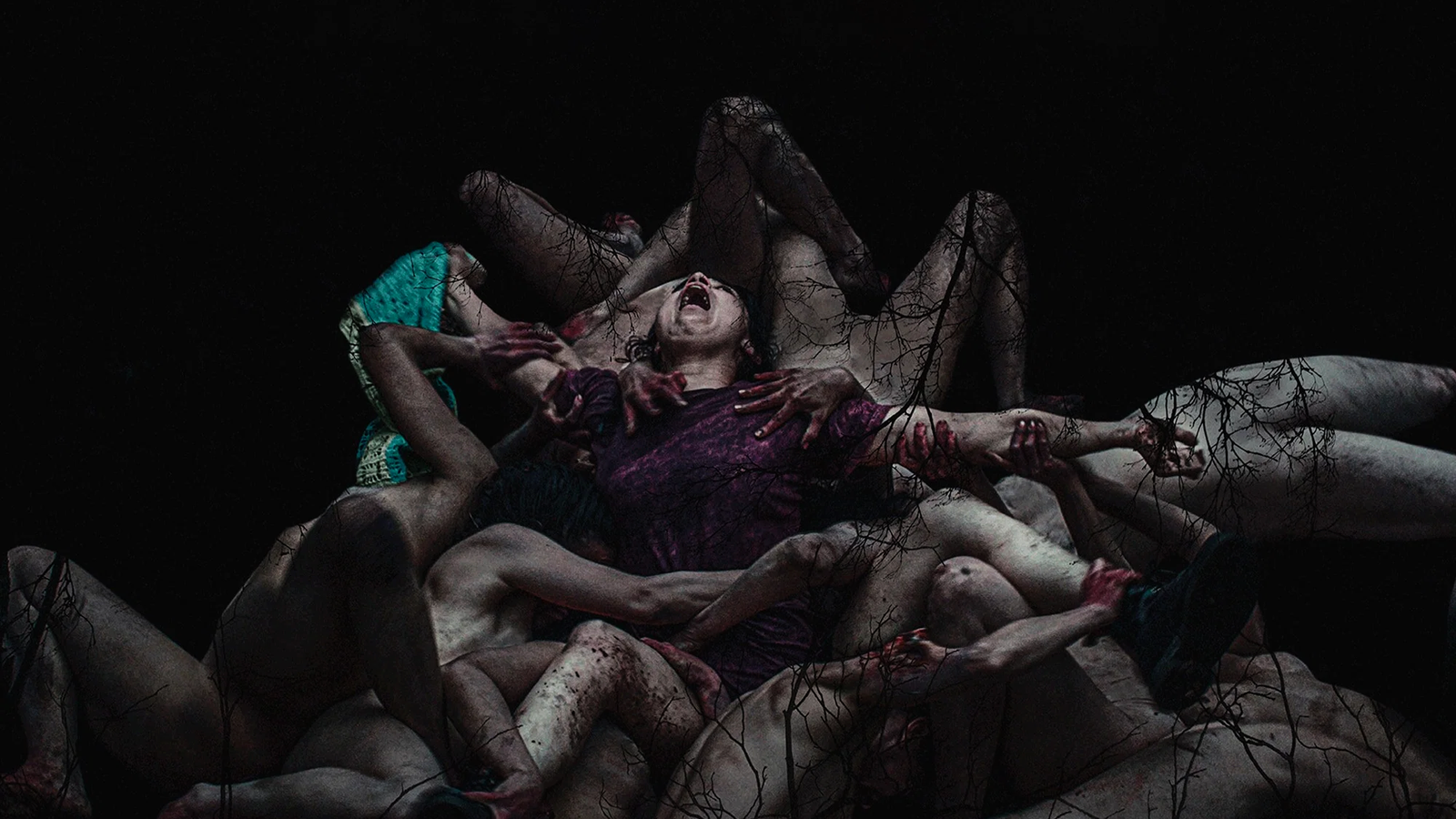
Michelle Garza Cervera modernizes Mexican folklore to explore motherhood's physical and metaphysical body horror. "When becoming a mother, you feel like you are breaking in two," Valeria's mother-in-law relates at one point about her own experience. And of course, Valeria's body changes as a second one grows inside her, but her identity starts to fracture as well. Valeria's a carpenter, but she has to give it up because the dust and stress could harm her baby. Raúl won't have sex with her now, viewing her as a womb to be protected instead of a woman with sexual needs and desires. Flashbacks to her past also suggest that this loss of identity to domesticity may have begun much earlier than she realized.
Natalia Solián's performance shows the physical and mental toll this takes on Valeria. What begins as a nervous tick of cracking her knuckles evolves into a full-on contortion of her body at each increasingly intense flashpoint. The sound design complements this, announcing Huesera's presence with bone-cracking that seems to come from everywhere and eventually becomes indistinguishable from Valeria's own. Solián also shows the disintegration of Valeria's mind, including the stresses of pregnancy, postpartum depression, and how the hauntings no one else believes are happening compound all that.
Michelle Garza Cervera directs Huesera as a slow burn, relying on surreal imagery, sound design, and a steady sense of disorientation instead of jump scares. She also wrote the movie, and she wrestles with the opening image of the Virgin Mary looming over the culture, asking why all women must want to become mothers. The movie offers answers, but they aren't prescriptive; they offer a perspective not usually found in mainstream stories about women struggling with motherhood. The result may be too abstract for some audiences, but that speaks to Cervera's confidence as a director and writer, and the conviction in her point of view.
