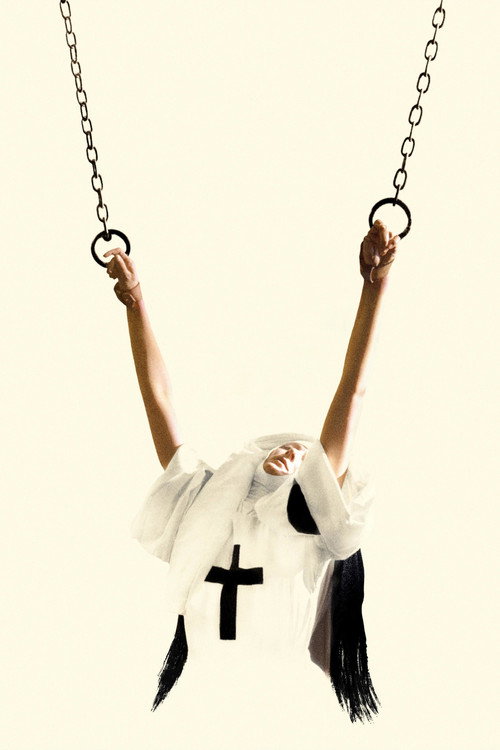


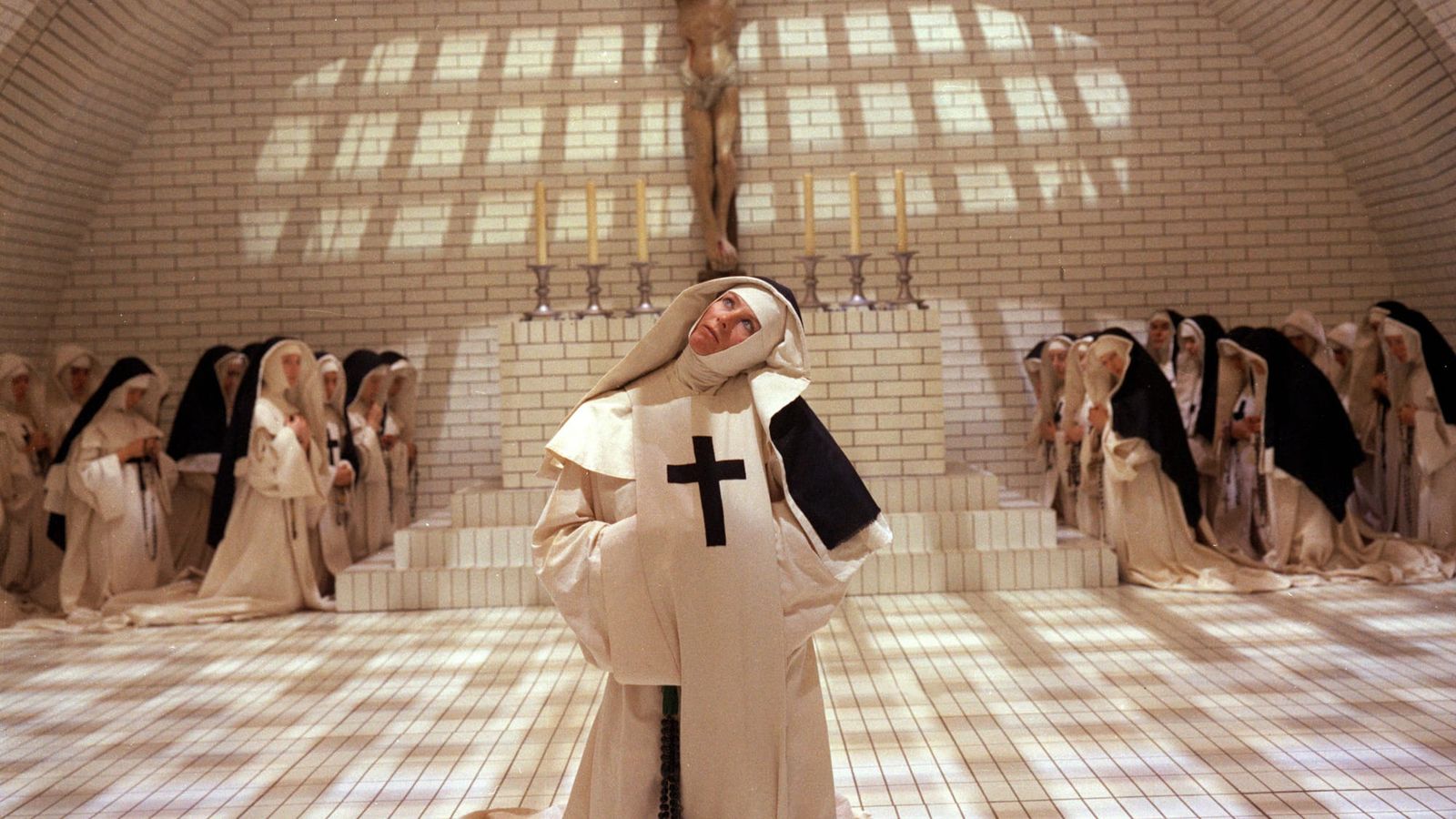
Oliver Reed stars as the burly, roguish Urbain Grandier, a lecherous priest made steward of the French city of Loudon after its governor dies. Grandier leads Loudon in defiance of Cardinal Richelieu (Christopher Logue), whose word in the ear of King Louis XIII (Graham Armitage) is absolute monarchy; Loudon is among the few holdouts. Sister Jeanne des Agnes (Vanessa Redgrave) harbors a deep lust for Grandier, ogling him from her convent's hidden chambers. Her obsession with him culminates in an accusation of carnal witchcraft, which the Cardinal's agents immediately latch on to bring Grandier and Loudon to heel. Church and state oppression collide with sexual repression as the city descends into pandemonium.
John Milton coined "pandemonium" to name the gathering place of all Hell's denizens in his epic poem Paradise Lost. It's since been used to describe Earthly hives of sin and wickedness or chaotic situations; perfectly apt for The Devils, Ken Russell's high-pitched nightmare about the Loudon possessions. It's been banned and censored since 1971, with Russell's original vision lost amid multiple versions until 2002, when film critic Mark Kermode pieced together a director's cut. This year, Warner Bros. imprint Clockwork announced a 4K restoration with a brief theatrical run, delighting cinephiles worldwide.
The Devils is an evergreen warning about the dangers of uniting the state and church. A show trial may be tamer than a show exorcism, but both grotesquely pervert their institutions; the exorcism reveals the film's themes more clearly. Cardinal Richelieu's church covets political power. Though Sister Jeanne's claims are initially investigated under a pretense of secular inquiry, the latest "scientific" witch-detection methods are brutal and violating. These acts expose the church's sexual repression, which it weaponizes in an exorcism that unleashes the film's centerpiece of sexual carnage. (No wonder the Vatican weighed in at the time; blasphemy had never felt so thrilling.) Yet even at its frenzied height, the church is reminded it is an extension of the state, not its equal.
This obscenity fuels the campaign against Grandier, but his real threat is his worldview, not his defiance of the Cardinal. A sincere priest, he rejects clerical celibacy and embraces his sexuality—or, more accurately, womanizing—arguing that denying his nature would deny God. Even if this excuses his promiscuity, he extends his ideals of morality and freedom beyond himself. He defends Loudon against the King's oppressive envoys, championing the city's religious tolerance and independence as fiercely as his beliefs. Oliver Reed combines conviction with raw sexuality, while revealing a deep sensitivity beneath his barrel chest in an introspective subplot that contrasts with the main story's chaos.
Where Grandier freely interprets church doctrine, Vanessa Redgrave's Sister Jeanne is constrained by it. Like the other young nuns in her care, she's been forced into "marriage" to Christ for having failed to meet societal standards of dowry or beauty, and her duty as abbess and her hunchback keep her bowed in perpetual submission. But even in submission, Vanessa Redgrave gives Jeanne a look in her eyes that betrays a passion and almost mischievousness to rival Grandier's. In another life, in another society, she'd be his equal.
On the production side, The Devils is a gorgeous nightmare. Derek Jarman's Loudon set is a massive black-and-white cityscape that eschews full period accuracy for an oppressive, modern sterility, particularly in the convent where most of the mayhem takes place. Cinematographer David Watkin composes lavish, phantasmagoric images from Jarman's production design and Shirley Ann Russell's costumes. At the same time, Peter Maxwell Davies' score conjures sacrilegious visions and a classic cacophony during the main possession sequence.
Ken Russell's The Devils is profane, maximalist cinema at its finest. 55 years of censorship and controversy have been redeemed, largely thanks to film critic Mark Kermode's tireless efforts to track down the missing footage and restore Russell's rapturous vision of fascism, repression, and carnality.